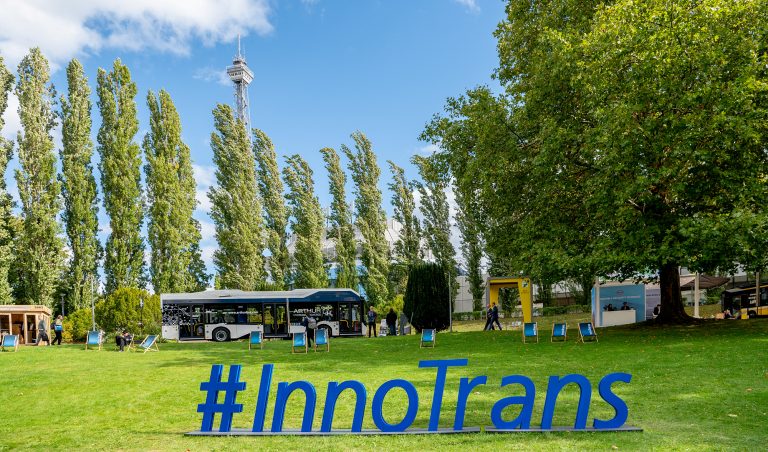
InnoTrans runs four days across roughly 200,000 square metres. Most overhead line engineers get two of those days, and most leave with a bag of brochures and no decisions. This guide is about leaving with something usable instead.
If you manage catenary or overhead contact line assets, InnoTrans is the only week in the two-year cycle where every supplier, standards body, and infrastructure manager you deal with is in the same building. That concentration is the value — and also the problem. The floor is built for breadth. Your job is narrow.
What follows is a planning guide written for that narrow job: how to structure two days, which of the show’s themes actually touch OHL infrastructure, how to read the measurement claims you’ll hear at every stand, and what to ask so that a fifteen-minute conversation produces something you can act on in October.
It is not a list of who to visit. You know your suppliers better than we do.
The basicsInnoTrans 2026 at a glance
InnoTrans is the world’s largest trade fair for transport technology, held every two years at Messe Berlin. The 2024 edition drew roughly 170,000 visitors and close to 3,000 exhibitors from around 60 countries. The 2026 edition runs 22–25 September.
The show splits into five segments — Railway Technology, Railway Infrastructure, Public Transport, Interiors, and Tunnel Construction — plus the outdoor track display, which is the part most trade fairs cannot replicate: several kilometres of live track with rolling stock parked on it, where you can stand under a raised pantograph rather than look at a render of one.
- Dates
- 22–25 September 2026
- Venue
- Messe Berlin, Germany
- Cycle
- Biennial · last 2024 · next 2028
- Segments
- 5 + outdoor track display
- Relevant to OHL
- Railway Infrastructure · Railway Technology
- Trade visitor days
- Tue–Thu · public access Fri
The biennial cadence matters more than it looks. Whatever you decide to evaluate at this show, you will most likely be living with that decision until 2028. Procurement cycles in rail infrastructure are long enough that a supplier conversation in September 2026 becomes a framework agreement in 2027 and a deployment in 2028. That is the real reason to arrive with a specification rather than curiosity.
Hall allocations and the outdoor display layout are published by Messe Berlin closer to the show and do change between editions. Confirm hall numbers against the official InnoTrans floor plan rather than a two-year-old memory of where everyone was in 2024.
ContextWhy this edition is different for OHL teams
At InnoTrans 2024, condition monitoring for overhead lines was largely a pilot conversation. Vendors showed dashboards. Infrastructure managers asked whether the data was trustworthy. Very few people were talking about budgets.
Two years on, the conversation has moved — not because the technology suddenly became credible, but because the pressures behind it got worse. European networks are running more services on ageing catenary. Electrification programmes are extending overhead line kilometres faster than inspection capacity is growing. And the maintenance workforce that traditionally carried tacit knowledge about which spans give trouble is retiring.
The practical consequence is that “we should look at condition-based maintenance” has become “we need to justify the inspection budget we already have.” That is a procurement conversation, and it changes what you should be doing on the floor. You are no longer collecting ideas. You are testing whether specific claims survive contact with your network.
Expect almost every stand in the infrastructure halls to say the word “AI” at some point during the four days. That is not, by itself, informative. The distinguishing question in 2026 is not whether a system detects anomalies — several do, reasonably well — but what happens in the twenty minutes after detection. Who is told. What they are told. Whether the output is specific enough to send a crew to a location, or vague enough that someone has to go and look anyway.
A monitoring system that replaces “inspect everything quarterly” with “inspect everything quarterly, plus watch a dashboard” has not saved anyone any money.
LogisticsHow to plan two days when the show is four
Most infrastructure teams send people for two days, often Tuesday and Wednesday. That is enough if the days are structured and nowhere near enough if they aren’t. A few things that consistently make the difference:
Book meetings before you arrive
Walk-up conversations at a busy stand get you a product overview from whoever is free. Booked meetings get you the engineer. The difference in a technical evaluation is enormous, and the good slots on Tuesday and Wednesday are gone by early September. If there are five suppliers you genuinely need to assess, book all five before the end of August.
Bring a specification, not a shopping list
The single most useful thing you can carry is a one-page description of your own network: electrification type (AC, DC, and which voltages), catenary designs in use, route kilometres, current inspection regime and interval, fleet types available for onboard equipment, and the two or three failure modes that actually cost you delay minutes.
Hand that page to a vendor and the conversation skips twenty minutes of generic positioning. It also exposes very quickly which suppliers can talk about your railway and which can only talk about their product.
Split the team by question, not by hall
If two of you are going, do not divide the floor geographically. Divide it by the question each of you needs answered — one person on measurement and data quality, one on integration, deployment and what the field crew actually receives. You will cover fewer stands and learn considerably more.
Use the outdoor display deliberately
The outdoor track is the only place at the show where you can see pantographs, roof equipment, and mounted sensors in their real geometry. If you are evaluating onboard monitoring, this is where you check whether a system that looks elegant in a slide can actually be installed on your roof, with your clearances, and survive your washing plant.
A workable two-day shape
| Slot | Focus | Why then |
|---|---|---|
| Day 1 · AM | Booked vendor meetings — measurement and data quality | Everyone is fresh and stands are quietest before 11:00 |
| Day 1 · PM | Outdoor track display — installation reality, roof equipment, clearances | Better light, and it takes longer than you expect |
| Day 1 · Close | 15 minutes writing up while it is still accurate | Day 2 overwrites Day 1 if you don’t |
| Day 2 · AM | Booked meetings — integration, deployment, field output | Second-round questions land better after seeing the hardware |
| Day 2 · Midday | Standards bodies, certification, and research stands | Quieter, and the people there will answer awkward questions honestly |
| Day 2 · PM | Return visits to the two suppliers worth a second conversation | The follow-up visit is where real detail comes out |
A structure, not a prescription — adjust to your own shortlist. The principle that matters is the write-up slot at the end of Day 1.
AgendaFive themes worth your time
InnoTrans covers everything from seat upholstery to signalling. These are the five threads that genuinely touch overhead line infrastructure, and what to ask when you encounter each of them.
1 · Condition-based maintenance moving from pilot to production
The interesting suppliers this year are the ones who can describe a deployment that has been running long enough to have survived a winter, a staff change, and a false alarm. Ask how long the longest continuous installation has been live, and what broke in year two.
2 · AI that produces decisions rather than dashboards
Anomaly detection is close to a commodity. The differentiator is prioritisation: given four hundred flagged points across a network, which twelve does a crew visit this week, and on what basis. Ask to see the ranking logic, not the detection demo.
3 · Sensor fusion on a single asset
Vibration, optical profiling, LiDAR, and thermal each answer a different question about the same wire. Systems that combine them can cross-validate; a geometric deviation that also shows a thermal signature is a very different maintenance priority from one that doesn’t. Ask which modalities a vendor actually runs simultaneously on the same vehicle, rather than which ones appear on the brochure.
4 · Simulation and validation before construction
Design-stage simulation of pantograph–catenary interaction has become considerably more accessible, which means the questions have shifted from “can you simulate this” to “is your simulation trusted by the people who approve my project.” That is a certification question, covered further down.
5 · Retrofit versus new-build
Nearly every monitoring system demonstrates beautifully on a purpose-built measurement vehicle. Very few networks can afford to run one. The commercially decisive question is whether the equipment can be installed on the in-service fleet you already operate, how much it weighs, what it needs from the vehicle, and what the homologation path looks like on your rolling stock.
For each of the five themes, ask the same closing question: “What does this not do?” Suppliers who answer it precisely are almost always the ones who understand their own technology. Suppliers who say “nothing, really” are selling.
TechnicalThe four ways to measure an overhead line — and what each one misses
You will hear four measurement approaches described on the floor, often in language that makes each sound complete. None of them is. Understanding what each physically cannot see is the fastest way to evaluate a monitoring claim, and it is the single most useful thing to have in your head before you walk in.
Vibration-based measurement
Accelerometers mounted on the pantograph head or roof capture the mechanical response of the pantograph–wire interaction, usually alongside a camera. Because a hard spot, a stiff clamp, a worn dropper or a misaligned registration arm all disturb that interaction, vibration data is very good at detecting that something is wrong at a specific location, continuously, on in-service vehicles.
What it cannot do is tell you the wire is 5,180 mm above rail. Vibration is a relative measurement — it detects deviation from normal behaviour, not absolute geometry. Treat any claim of absolute height measurement from accelerometers alone with scepticism.
Optical profiling
Infrared optical systems — commonly around 850 nm — measure contact wire height, stagger, and remaining thickness by imaging the wire against a controlled illumination source. This gives you the geometric and wear picture: how the wire is positioned and how much of it is left.
Its limits are environmental and structural. Heavy contamination, unusual reflectivity, or extreme lighting can degrade readings, and it tells you nothing about the electrical or thermal condition of a joint. It measures the wire’s shape, not its health as a conductor.
LiDAR
Laser scanning produces absolute three-dimensional position of the contact wire and surrounding structures, largely independent of how the vehicle is moving. That independence is the point: where optical and vibration methods are affected by vehicle dynamics, LiDAR gives you a geometric reference you can trust for clearance and absolute stagger verification.
It is comparatively poor at fine wear measurement — resolving a fraction of a millimetre of contact wire thickness loss is not what a scanner is built for — and, like optical profiling, it says nothing about temperature or arcing.
Thermal imaging
Long-wave infrared imaging of the contact zone detects hotspots: arcing events, resistive joints, overheating clamps and connectors. These are electrical faults that geometry-based methods will not find, because a badly made connection can sit in a perfectly positioned wire.
Thermal is essentially blind to geometry, and readings are sensitive to ambient conditions and emissivity. It is a complement, never a substitute.
| Method | Detects well | Cannot see | Best used for |
|---|---|---|---|
| Vibration | Hard spots, abnormal impacts, contact irregularities, dropper and clamp faults | Absolute geometry; thermal and electrical condition | Continuous anomaly detection on in-service fleet |
| Optical profiling | Contact wire height, stagger, remaining thickness and wear rate | Electrical or thermal condition; degraded by heavy contamination | Geometric compliance and wear trending |
| LiDAR | Absolute 3D wire position and stagger, independent of vehicle dynamics | Fine wear thickness; thermal condition | Absolute geometry verification and clearance |
| Thermal | Contact-zone hotspots, arcing risk, resistive joints and thermal stress | Geometry entirely; sensitive to ambient conditions | Electrical connection faults and arcing risk |
No single modality gives a complete picture of overhead line condition. The most useful question at any monitoring stand is which of these four a system actually runs — and which it quietly leaves out.
The practical takeaway for the floor: when a vendor describes their system, map it against these four columns as they speak. If a claim spans more than one column, ask which sensor produces it. The answer is usually clarifying, in one direction or the other.
We go deeper on two of these in separate articles — how vibration data identifies hard spots, and what continuous contact wire wear measurement involves.
EvaluationWhat to actually ask a monitoring vendor
Fifteen minutes at a stand is enough for five good questions. These five separate systems that are ready for a network from systems that are ready for a demonstration.
What is the false-positive rate, and how did you measure it?
Every detection system produces them. A vendor who quotes a number and explains the ground-truth method is being straight with you. A vendor who says the rate is negligible has not deployed at scale.
Show me what the field technician actually receives.
Not the management dashboard — the output that reaches the person with the ladder. Location precision, defect description, severity, and what they are meant to do about it.
How is severity scored, and can I see the logic?
If prioritisation is a black box, you cannot defend a maintenance decision to a regulator or an internal auditor. You need to be able to explain why point 41 was visited before point 78.
What does installation require on our existing fleet?
Weight, power, data connection, mounting, clearance, homologation path, and time out of service. This is where most retrofit projects actually stall.
What happens between detection and repair?
The gap between knowing and acting is where most monitoring investments quietly fail. Ask them to walk the full chain, from sensor reading to closed work order.
Which of these four do you not measure?
Referring to the table above. The answer tells you where the blind spots in the system are, and whether the vendor is willing to name them.
If you want the longer version, we have written up twelve questions to ask any overhead line monitoring vendor, including the procurement and data-ownership questions that matter later but rarely come up on a trade show floor.
StandardsSimulation and certification: what EN 50318 really means
If any part of your work involves designing, upgrading or validating catenary, you will encounter simulation tools at this show, and you will hear the phrase “EN 50318 certified” used loosely. It is worth knowing precisely what it does and does not mean before you rely on it.
EN 50318 is the European standard governing the validation of simulation of dynamic interaction between pantograph and overhead contact line. The current version is EN 50318:2018, amended by A1:2022. It defines reference cases against which a simulation tool’s results are compared, so that an independent body can confirm the tool reproduces known physical behaviour within defined tolerances.
The critical point for a buyer — and the one most often glossed over — is that certification is scenario-specific, not blanket. A tool validated against an AC simple overhead contact line reference case has not thereby been validated for DC systems, or for stitched configurations. Those are separate assessments producing separate certificates.
Four questions, in order: Which scenarios are certified? (AC simple, AC stitched, DC simple, others) · What are the certificate numbers? · Which body issued them? · Which software version was certified?
A supplier with genuine certification can answer all four immediately and will usually hand you the certificates. Anything vaguer than that is worth probing.
The last of those four matters more than it sounds. Certification attaches to a specific version of a simulation engine. If a tool was certified at version 2 and you are being sold version 4, ask what changed and whether the certification was renewed.
For context on our own position: PANTO Simulation holds three certificates issued by SCONRAIL AG in Winterthur against EN 50318:2018/A1:2022 — OCL AC simple (GI-12196/V01), OCL AC stitched (GI-12197/V01), and OCL DC simple (GI-12198/V01), all for engine version 3.0.0. We list them individually rather than as a single claim precisely because the distinction is the thing that matters.
We have written a fuller explainer on what EN 50318 certification involves and how to read a certificate, which is worth ten minutes before you talk to any simulation supplier.
AfterwardsHow to leave with something usable
The most common failure mode at InnoTrans is not choosing badly. It is coming back with forty business cards, a genuine sense that three suppliers looked promising, and no record of why — and then losing four weeks reconstructing it.
Three habits fix most of that.
Write up at the end of each day, not at the end of the week. Fifteen minutes, three lines per conversation: what they claim, what they could not answer, what the next step would be. Day 2 genuinely does overwrite Day 1 in memory, and by the following Monday the distinctions have blurred.
Record the unanswered questions specifically. The gaps are more diagnostic than the answers. If a supplier could not tell you their false-positive rate on Tuesday, that is the first thing to put in the follow-up email — and how quickly and precisely they respond tells you a great deal about what working with them will be like.
Agree the next step while you are standing there. Not “we’ll be in touch” but something concrete: a technical session with your engineering team, a data sample from a comparable network, a written response to your specification page. Vague endings produce nothing. A supplier who will not commit to a specific next step at the show will not become more committed in November.
And be realistic about scope. Two days is enough to seriously evaluate three or four suppliers. It is not enough to evaluate twelve, and attempting it produces twelve shallow impressions rather than three usable assessments.
Meet usWhere to find PANTOhealth
We will be in Hall 22, Stand 400 for all four days. PANTOhealth is a Berlin-based company working on overhead line condition monitoring and pantograph–catenary simulation, currently deployed across 12 countries and more than 5,000 km of network.
What we are demonstrating, in the terms used above: all four measurement modalities — vibration, optical profiling, LiDAR and thermal — feeding a single monitoring platform that scores and ranks locations, plus our EN 50318-certified simulation environment.
If you want a technical conversation rather than a product tour, book a slot in advance. Bring your specification page. We would rather spend the time on your network than on our slides.
Book a meeting at InnoTrans 2026
Thirty minutes with an engineer, not a product tour. Tell us about your network and we will tell you honestly whether we can help.
- 12 questions to ask any overhead line monitoring vendor
- Overhead line failures: seven common causes and how to detect them early
- Hard spots in overhead contact lines, and how vibration data finds them
- Contact wire wear: measuring height, stagger and thickness continuously
- What is EN 50318? A plain-English guide to catenary simulation certification
- Overhead line monitoring glossary: OCL, OHL, catenary, pantograph and more